
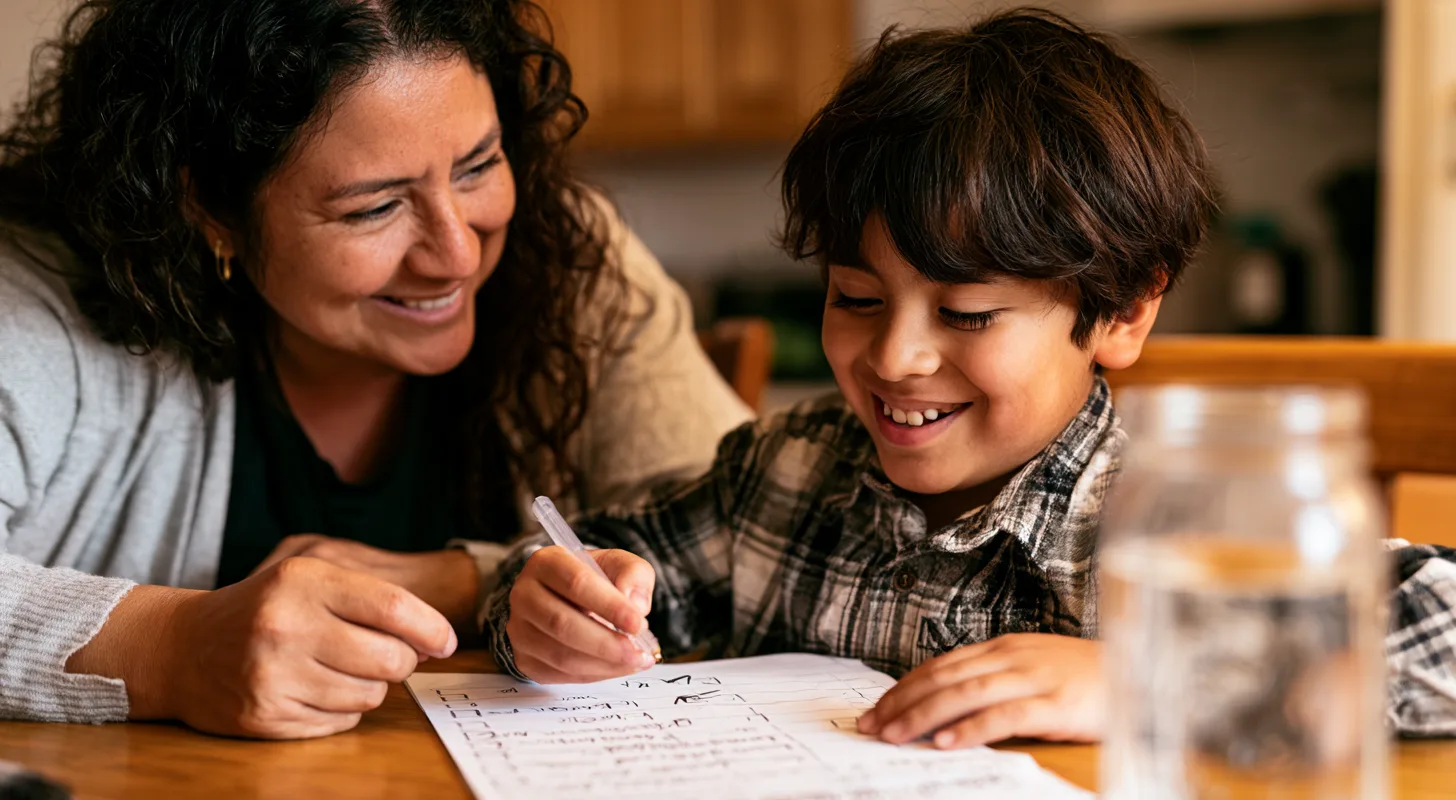
Your child has ADHD and, lately, everything has become a battle: homework, reading, even the activities they used to love. You feel like you’re pushing on a locked door. Take a breath: an ADHD child’s motivation hasn’t vanished — it has simply gone dormant. And there are simple steps, ones you can try tonight, to rekindle it without yelling or bribing.
In this article, you’ll understand why the engine of motivation works differently in an ADHD brain, how to stop confusing a stalled drive with bad will, and above all what to do concretely, step by step. No miracle recipes — just gentle, tested levers that respect both your child and your energy as a parent.
📋 The essentials at a glance
- The problem: in an ADHD child, motivation depends heavily on interest and immediate reward, far less on “willpower.”
- The cause: the dopamine system, which runs on novelty and pleasure, is less responsive to long, abstract tasks.
- The solution: make tasks shorter, more concrete, more stimulating, and celebrate micro-wins.
- Your role: shift from “supervisor” to “ally,” lower the pressure, and rebuild confidence.
- Bottom line: motivation comes back in small touches, not through one big speech.
Why motivation fades in a child with ADHD
To understand it, you have to look under the hood. In the brain, motivation rests largely on dopamine, a chemical messenger tied to pleasure and the anticipation of reward. In people with ADHD, this system runs in slow motion for anything that’s distant, repetitive, or abstract. A math assignment due “next week” sends almost no signal to the brain. A video game, on the other hand, rewards every second.
So it isn’t that your child doesn’t care about succeeding. It’s that their brain struggles to turn a distant goal into energy right now. We often speak of “time blindness”: the future feels unreal, and only immediate things carry weight. As a result, the child waits until the last minute, panics, then gives up.
On top of this there’s an emotional history. Many ADHD children have piled up negative comments: “focus,” “you can do better,” “forgot again?” Each failure leaves a mark. Little by little, the child protects themselves by no longer trying: if I don’t try, I can’t fail. This giving-up isn’t laziness — it’s armor. Understanding that changes everything in how you help, which is also why it’s worth understanding how ADHD shapes learning before looking for solutions.

Stop confusing laziness with a motivation stall
Here is the most common — and most painful — misunderstanding: believing the child “doesn’t want to.” In reality, they often want to very badly, but they can’t get themselves moving. The difference is huge. Laziness is not wanting to act. An ADHD motivation stall is wanting to act without managing to start.
How do you tell the difference day to day? Watch the gap between intention and action. A child who says “I’m going to do it” ten times, sits down, takes out their things, then ends up staring at the wall, isn’t lazy. They’re stuck at the starting phase — the one their executive functions handle with difficulty.
Shifting your perspective has an immediate effect. When you stop saying “make an effort” and start asking “what’s hard to get started here?”, you move from opponent to teammate. The child feels understood rather than judged, and the tension drops a notch. That simple change of stance is often the first spark of a lasting recovery.
💡 Tip — Replace “Why haven’t you started?” with “Shall we just do the first line together?” Starting is the highest step for an ADHD brain: help them over it, and the rest often follows on its own.
Make tasks shorter and more concrete
The golden rule for reigniting ADHD motivation comes down to one word: break it down. A task seen as a mountain paralyzes; a task broken into steps becomes climbable. “Do your homework” is too vague. “Read the first question out loud” is doable.
In practice, turn each big task into micro-steps of 2 to 10 minutes. Instead of “clean your room,” suggest “just pick up the clothes on the floor.” Instead of “study your spelling,” aim for “write three words, then we take a break.” Each small step completed releases a mini-dose of satisfaction — exactly the fuel that’s missing.
The timer is your best ally. The “10-minute sprint” technique works very well: you commit to working for only ten minutes, not one more. Often, the child keeps going on their own, because the hardest part — starting — is behind them. And if they stop at ten minutes, that’s still a win: they did something. To go further, these principles align with what helps your child concentrate without burning out.
📌 Good to know — Making the breakdown visible helps enormously. Write the micro-steps on sticky notes, one per sheet, and let your child tear one off with each success. Watching the pile shrink makes progress tangible and makes them want to keep going.
The words that rekindle motivation
What you say matters as much as what you do. ADHD children are hypersensitive to tone and judgment. A few well-chosen phrasings can turn an entire evening around.
Favor sentences that describe effort rather than results: “I saw you got back to work after your break — that’s real strength” is worth a thousand times more than “well done, you got a good grade.” The first feeds internal motivation; the second makes it dependent on performance.
Offer choices too, even small ones. “Do you start with French or with math?” restores a sense of control, essential for a child who often feels directed. Choice reawakens engagement.
Finally, name the emotion before the solution. “I can see this is frustrating you, that’s normal, it’s hard” defuses the crisis. An overwhelmed child can’t hear any advice until they feel understood. Validate first, then guide.
Build small wins that add up
Motivation rebuilds like a muscle: through short, successful repetitions. A child who strings together ten small wins regains confidence far faster than with one big one-off feat. It’s the “snowball” effect of success.
Set up a visual progress system: a chart, stickers, a gauge to color in. What matters isn’t the material reward but seeing the distance covered. The ADHD brain loves the concrete and the visual.
Beware the reward trap: rewards work in the short term, but if they become the only reason to act, internal motivation fades. Use them as a starting nudge, then gradually replace them with shared pride: “look at everything you managed this week.”
Celebrate invisible efforts too. Asking for help, starting over after a mistake, holding on for ten minutes — these are real victories. By naming them, you teach your child to be proud of their process, not just their grades. This small-steps logic works very well in tense moments, such as when you’re trying to turn homework time into something livable.

Tap into play, movement, and passions
The ADHD brain lights up with novelty, challenge, and pleasure. Instead of fighting this trait, put it to work. Turning a task into a game isn’t cheating: it’s speaking your child’s brain’s language.
A few concrete ideas: revise by setting a timed challenge, learn a lesson by turning it into a quiz, write by inventing an absurd story, do math standing at a board rather than seated. Movement helps a great deal too. Many ADHD children remember better while moving: let your child pace while reciting, squeeze a stress ball, or work standing up.
Above all, plug learning into their passions. A child wild about dinosaurs will read a text about dinosaurs better. A soccer fan will more happily count goals than apples. Interest is the most powerful fuel of all: use it as an on-ramp toward the drier subjects.
🔬 What the science says
Neuroscience research suggests that motivation depends largely on the dopamine circuit, and that this circuit responds more to immediate rewards and interesting activities. In ADHD profiles, studies indicate that tasks carrying novelty, movement, or personal meaning are engaged with more readily than long, monotonous ones. In other words, making an activity more stimulating isn’t a whim: it’s a strategy aligned with how the brain actually works.

Give it meaning: connect the effort to what matters to them
An ADHD child gets going far more easily when they understand why a task matters, in their own words. “Because it’s important” or “because I said so” weighs nothing against a brain that demands the concrete. Connecting learning to a personal goal, on the other hand, can change everything.
Take the time to discover what makes your child’s eyes light up. Do they want to become a veterinarian, build video games, play on a hockey team? Use that dream as a through-line. “To understand animals, vets read a lot — just like you did” suddenly gives reading a purpose. The effort stops being an imposed chore and becomes a step toward something that belongs to them.
You can also set small goals together that they choose, rather than ones you dictate. A child who decides “this week, I want to read a page without stopping” invests far more than when facing a demand handed down from above. The feeling of authoring their own goal multiplies engagement.
Finally, tell the story of progress over time. Remind them where they started: “remember, back in September it was hard to last five minutes? Now you do fifteen.” Seeing their own growth gives the child proof that effort pays off, and feeds the desire to keep going. Over the long run, meaning and pride are far sturdier fuels than any reward.

Set up a reassuring, predictable framework
Paradoxically, a child who needs novelty also needs stable landmarks. A clear routine lowers mental load and frees up energy for effort. When the child knows homework always happens at the same time, in the same place, they no longer have to “decide” to start: it’s automatic.
Look after the environment. A tidy space, no screen within reach, with only the needed materials, cuts down on sources of distraction. Get things ready in advance to avoid the discouragement of “I can’t find anything.”
Announce transitions. Moving from a pleasant activity to a hard task is very tough for an ADHD brain. Give warning: “in five minutes, we tidy up and start reading.” This simple buffer prevents many meltdowns. A reassuring routine doesn’t trap the child: it gives them stable ground to push off from.
💡 Tip — Create a small start-up ritual that’s always identical: a glass of water, switch on the desk lamp, set the timer. Repeated every day, this ritual becomes a signal to the brain: “it’s time to focus,” without having to dig into willpower.
Protect your own energy as a parent
It’s often forgotten: to reignite a child’s motivation, the parent needs to keep a bit of fuel too. Supporting an ADHD child takes immense patience, and it’s normal to feel exhausted, sometimes discouraged. You’re not a bad parent because you lose patience on a night of endless homework. You’re a human parent in a demanding situation.
The first strategy is to lower your own expectations for the day when the tank is empty. Not every evening is the same. On some days, the realistic goal isn’t “finish all the homework,” but “end the evening without a meltdown and with the bond intact.” Picking your battles isn’t giving up: it’s lasting.
Think about sharing the load too. If there are two parents, take turns supporting homework so the same person isn’t always absorbing the tension. Ask for support from the teacher, a loved one, a group of parents going through the same thing. Talking with other families relieves guilt enormously and surfaces ideas you’d never have had alone.
Finally, allow yourself guilt-free micro-breaks. Five minutes to breathe before responding to a crisis is worth more than a heated reaction you’ll regret. Your calm is contagious: a steady parent helps a child self-regulate far faster than a frazzled one. Taking care of yourself isn’t turning away from your child — it’s giving yourself the means to support them over the long haul.
📌 Good to know — Emotional regulation is passed on. When you calmly name your own state (“I feel myself getting impatient, I’m taking a breath”), you offer your child a precious model for handling their own inner storms.
When motivation doesn’t come back: what to do
Sometimes, despite all your efforts, the child stays switched off, sad, or persistently angry. It’s important then not to carry it all alone. Demotivation that lasts can hide something else: anxiety, an associated learning difficulty, or badly damaged self-esteem.
A few signals that call for help: a child who constantly puts themselves down (“I’m useless”), who refuses school to the point of crying in the morning, who withdraws, or whose mood changes lastingly. In these cases, talk to the teacher, the school psychologist, or your doctor. You’re not “failing”: you’re seeking the right support, and that’s exactly what a good parent does.
Also keep time for the relationship itself, with no learning goal attached. Playing, laughing, cooking together expecting nothing reminds the child they’re loved for who they are, not for their results. It’s this emotional foundation that, in the long run, gives back the courage to try.
| ✅ Do | ⛔ Avoid |
|---|---|
| Break tasks into micro-steps of a few minutes | Demand one long, single block of work |
| Praise the effort and the start | Value only good grades |
| Offer choices to restore a sense of control | Impose everything and pile on orders |
| Validate the emotion before offering a solution | Say “calm down” or “it’s no big deal” |
| Plug learning into their passions | Repeat “make an effort” without changing anything |
FAQ
Is my ADHD child really lazy?
Almost never. What looks like laziness is most often a difficulty starting and sustaining effort, tied to how executive functions work. The child usually wants to succeed, but their brain struggles to turn intention into action. Shifting your perspective and helping them over the starting step solves a large part of the problem.
Are rewards a good idea?
Yes, but with care. Small rewards help kick off a hard task and create quick wins. The risk is that they become the only reason to act. Use them as a starting nudge, then gradually replace them with shared pride and the pleasure of having succeeded, which feed a more lasting motivation.
How long can an ADHD child stay focused?
It varies with age and interest, but many ADHD children do better in short blocks of 5 to 15 minutes, followed by a real break. Rather than aiming for one long session, multiply small blocks with movement breaks. Focus is managed in sprints, not marathons.
Should I cut out screens entirely?
Not necessarily. Screens aren’t the enemy in themselves, but they strongly capture ADHD attention and make schoolwork less appealing by contrast. It’s better to frame them: no screens during work, and use them sometimes as a learning tool or as a clearly bounded moment of pleasure.
When should I consult a professional?
If demotivation settles in lastingly, comes with sadness, anxiety, a strong rejection of school, or repeated self-deprecating phrases, talk to the teacher, the school psychologist, or your doctor. Asking for help isn’t a failure: it’s finding the right support for your child and for yourself.
Conclusion
An ADHD child’s motivation isn’t a switch — it’s a flame you shield from the wind. It flickers when tasks are too big, when pressure rises, when failures pile up. It comes back to life when you break things down, when you encourage, when you make learning vivid, and when you love the child for who they are. You don’t have to get everything right at once: one micro-step today, one encouraging word tomorrow, and confidence returns, little by little. At KIADEMY, we believe every child can rediscover the joy of learning when they’re offered the right hand at the right moment.
Was this article helpful?


