
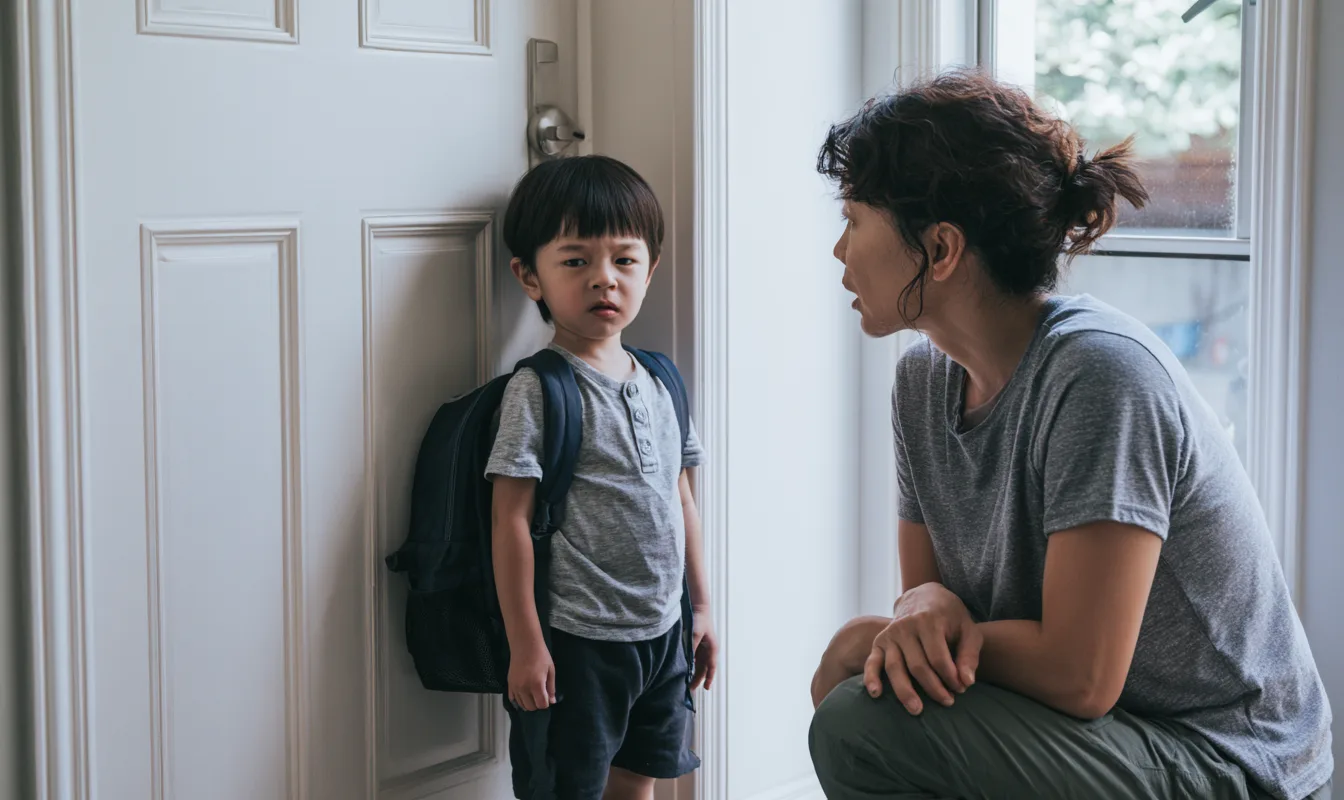
“I don’t want to go.” Those few words, tossed out on a weekday morning, are enough to sour the mood and squeeze your heart. You watch your child drag their feet, sigh at the sight of their backpack, sometimes burst into tears at the thought of a spelling test. And you swing between worry and frustration, unsure what to do. Take a breath. A child who doesn’t like school is not a lazy or badly raised child. Almost always, they’re a child trying to tell you something. This article gives you concrete levers, ready to use this week, to rekindle their motivation without pressure and without turning every morning into a battle.
How do you motivate a child who doesn’t like school?
Start by looking for the cause of the block (boredom, difficulty, anxiety, relationships) rather than forcing things. Then lean on three levers that research links to lasting motivation: autonomy (giving them choices), a sense of competence (achievable successes), and connection (feeling supported). Praise effort, not the grade, and reconnect learning to what they’re passionate about.
📋 The essentials at a glance
Before the details, here’s a map of the problem and the solutions:
- Problem: “I’m bored.” → Connect subjects to their interests and offer small, stimulating challenges.
- Problem: “It’s too hard.” → Break tasks down, celebrate every small step, check for a learning difficulty.
- Problem: “I’m scared.” → Ease the anxiety, take the drama out of mistakes, meet with the teacher.
- Problem: “Nobody gets me.” → Strengthen the bond, listen without judging, be their ally at school.
- Master lever: replace pressure (“you have to”) with autonomy and meaning (“here’s why, and you choose how”).
Why your child doesn’t like school: understand before you act
The first, very natural mistake is trying to correct the behaviour before understanding its root. But “I don’t like school” is a catch-all phrase. It can hold a thousand very different things: a friend who made fun of them, a subject they don’t understand, a teacher who scares them, a pace that exhausts them, or simply deep boredom.
A child doesn’t wake up one morning deciding to hate school. The dislike settles in layer by layer, often silently. At six, you love “playing school”; at nine, you drag your feet; at twelve, you dig in your heels. Somewhere in between, something happened: repeated failures, eroded confidence, the feeling of never measuring up.
The good news is that motivation is not a fixed personality trait. It’s a state that depends on context. The same child can be switched off in class and passionate at home in front of a project that lights them up. Your job, then, isn’t to “manufacture” motivation by force, but to remove the obstacles that keep it from showing.
To dig into the underlying mechanics, the guide on understanding your child’s school motivation breaks down what feeds and what kills the desire to learn.
Spotting the real cause behind “I don’t like school”
Before acting, play detective, without the interrogation. Children shut down the moment they sense you’re looking for someone to blame. Favour open questions, asked in a relaxed moment, in the car or at bedtime.
Try: “If you could change one thing about school, what would it be?” or “What’s the worst part of your day? And the best?” These phrasings get around the wall of “it’s fine” and open a real conversation.
The four big families of blocks
Most school aversions fall into four buckets. Boredom: the child isn’t stimulated enough, the pace doesn’t suit them. Difficulty: they struggle, fall behind, and effort feels pointless because they fail anyway. Anxiety: fear of evaluation, fear of others’ eyes, fear of disappointing. The social side: conflict with a classmate, isolation, a strained relationship with an adult.
📌 Good to know: these families often combine. A child struggling with reading ends up developing anxiety, which pushes them to avoid, which widens the gap. Identifying the starting bucket helps you break the cycle in the right place.
If you suspect that effort produces little result despite real goodwill, don’t sit alone with your doubts: the article on learning difficulties and disorders: what you need to know helps you tell a simple rough patch from a need for specialized support.
The secret to lasting motivation: autonomy, competence, connection
If you remember only one thing, make it this. The work of Edward Deci and Richard Ryan on self-determination theory showed that deep motivation rests on three fundamental psychological needs: feeling autonomous (having choices), feeling competent (succeeding at things within reach), and feeling connected (being supported, accepted). When these three needs are met, the desire to learn returns almost on its own. When they’re frustrated, no reward or punishment holds over time.
In practice, autonomy doesn’t mean “let them do whatever.” It means offering choices within a clear frame. “Do you want to do your math before or after your snack?” The homework stays mandatory, but the child keeps a grip on the how. That simple sense of control changes everything: we cooperate far more willingly with a decision we helped make.
Competence is built through visible successes. A child who fails over and over ends up concluding they’re “dumb,” and stops trying to protect themselves. Your mission: let them experience small, regular wins, at their level, to rebuild confidence grain by grain.
💡 Tip: every evening, ask them for just one thing they succeeded at during the day, however tiny. “I raised my hand once.” “I understood a division.” You’re training their brain to spot their wins rather than their gaps.
8 concrete levers to rekindle motivation
Here are the moves you can make starting this week. No need to apply them all at once: pick two or three and stick with them over time.
1. Connect learning to their passions
Your child loves dinosaurs, soccer, Minecraft? Use it. Count the goals, measure the fields, read a book about volcanoes. When knowledge serves a passion, it stops being a chore. School becomes a tool in the service of what already lights them up, not a parallel universe cut off from their real life.
2. Break the mountains into hills
“Do your homework” is crushing. “Let’s start with the first two questions, just that” is doable. A demotivated child’s brain overloads at the sheer size of the task. By breaking it up, you turn the impossible into a series of manageable small steps.
3. Praise effort, never only the result
“You’re smart” adds pressure: if I fail, it means I’m not anymore. “You really worked hard on that problem” praises what they control: their commitment. This nuance, studied by researcher Carol Dweck, changes the child’s relationship to failure and encourages them to persevere.
4. Turn mistakes into information
In many children’s minds, a mistake equals shame. Flip that reflex. “Great, this mistake shows us exactly what we need to review.” The error becomes a compass, not a verdict. A child who’s no longer afraid to be wrong dares, explores, and relearns to love a challenge.
5. Build a positive ritual around school
A drive where you sing along, a special snack on the way home, ten minutes of screen-free chat in the evening. These emotional anchors surround school with pleasant feelings. The child no longer associates school only with stress, but also with gentle moments with you.
6. Give them a role and responsibilities
Feeling useful feeds motivation. Ask them to explain a concept to their little brother, to prepare the materials, to choose the order of their homework. Becoming “the one who knows” or “the one in charge” restores the pride of learning.
7. Protect sleep and movement
A tired or overly sedentary child simply doesn’t have the fuel to invest. Sleep consolidates learning; active play releases stress. Before reaching for sophisticated techniques, check these simple physiological basics.
8. Become their ally, not their second teacher
By evening, your child has already had their fill of evaluation. If they see you as one more inspector, they’ll dig in. Stand beside them, facing the problem together: “Let’s look at this together, you and me against this exercise.” This teammate stance defuses homework conflicts.
Other complementary ideas are developed in how to motivate my child to learn day to day, worth a read if you want to go further.
What to say (and what to avoid)
The words we use, often without thinking, shape a child’s relationship to school. Here’s a quick guide.
| Avoid ❌ | Prefer ✅ |
|---|---|
| “You’re lazy.” | “I can see this is hard for you right now.” |
| “At your age, I had no choice.” | “What would help you get started?” |
| “Another bad grade!” | “Let’s look together at what we can understand here.” |
| “If you don’t work, you’ll ruin your life.” | “Every small step counts, and I’m here.” |
| “Why aren’t you like your sister?” | “You have your own way of learning.” |
📌 Good to know: comparing a child to a sibling or classmate is one of the most powerful demotivators. It sends the message “you’re not good enough,” the exact opposite of what a child needs to bounce back.
A concrete example: Léa’s before and after
Léa, nine, cried every Sunday night. “I hate school, I’m terrible at math.” Her parents, at first, tightened the screws: more homework, less screen time, threats. The result? Léa dug in even harder, and the evenings turned into drama. The power struggle only amplified the rejection.
Then they changed their approach. Instead of “How many more bad grades?” they asked: “What exactly is the sticking point in math?” Léa finally let it out: “I don’t understand fractions at all, and then the teacher goes too fast.” The real problem wasn’t laziness, but a gap in understanding that widened with every lesson.
So her parents broke it down: ten minutes of fractions a night, with concrete objects, praising every bit of progress. “See, yesterday you were stuck here, today you got it.” Within three weeks, Léa no longer cried on Sundays. She didn’t love math yet, but she had regained the essential: the belief that she could do it. That’s exactly what the shift from pressure to support produces.
💡 Tip: keep a notebook, week after week, of your child’s small advances. School progress is often invisible day to day but striking over a month. That notebook becomes tangible proof, for them and for you, that effort pays off.
When the aversion hides a learning difficulty
Sometimes, behind “I don’t like school” hides an invisible obstacle: dyslexia, dyscalculia, an attention disorder, performance anxiety. The child isn’t demotivated out of laziness; they’re avoiding a situation where they genuinely suffer.
The signals worth your attention: a marked gap between the child’s obvious intelligence and their results, disproportionate fatigue after homework, recurring stomach aches on school mornings, or a sudden, unexplained drop in grades.
In that case, effort alone won’t be enough, and pushing harder risks deepening the rejection. The right move is to meet with the teacher, then, if needed, consult a professional (a learning specialist, a school psychologist). Better to understand early than to feel guilty for a long time.
🔬 What the science says: research in the psychology of motivation suggests that external rewards (money, gifts, points) can erode spontaneous interest in an activity when they become the only driver. Conversely, feeding the need for autonomy, competence, and connection — the three pillars of Deci and Ryan’s self-determination theory — fosters more stable, deeper motivation. In other words, bribing a child to work succeeds in the short term, but giving them back the desire to learn works for life.
FAQ
My child doesn’t like school — is that serious?
Not necessarily. Many children go through passing phases of dislike tied to a change, fatigue, or a conflict. It becomes concerning if the aversion lasts several weeks, comes with physical symptoms, or with withdrawal. In that case, talk to the teacher and, if needed, a professional.
Should you force a child to go to school?
School remains mandatory, but forcing without understanding often makes the block worse. Keep the frame while looking for the cause: a child who feels heard cooperates more. If the refusal becomes massive or anxious (school refusal), specialized help is recommended over a daily tug-of-war.
How can you motivate without rewards or punishments?
By leaning on meaning and autonomy. Explain what they’re learning is for, offer choices in the how, and celebrate their effort. Occasional rewards aren’t forbidden, but they shouldn’t become the only fuel: the goal is to rekindle the joy of learning, not to buy obedience.
At what age can a child become demotivated?
Very early, sometimes as soon as first grade, especially when difficulties go unnoticed. Demotivation isn’t a question of age but of accumulated experiences. The earlier you step in, the easier it is to reverse the trend before “I’m dumb” settles in for good.
What if the teacher or a classmate is the problem?
Take the complaint seriously without dramatizing. Ask for specific examples, then request a meeting with the teacher in a spirit of collaboration. For a conflict between children, help yours name what they feel and involve the school. Feeling supported by you is, in itself, a powerful remotivating factor.
Conclusion
A child who doesn’t like school is never a lost child. They’re a child who needs to be heard, unburdened, and given small victories back. Look for the cause before the solution, feed their autonomy, praise their effort, and hold steady in kindness: motivation rarely returns all at once, but it does return. At KIADEMY, we believe a child supported with patience and the right tools almost always rediscovers the taste for learning. Your patience today is the surest investment in their confidence tomorrow.
Was this article helpful?


