

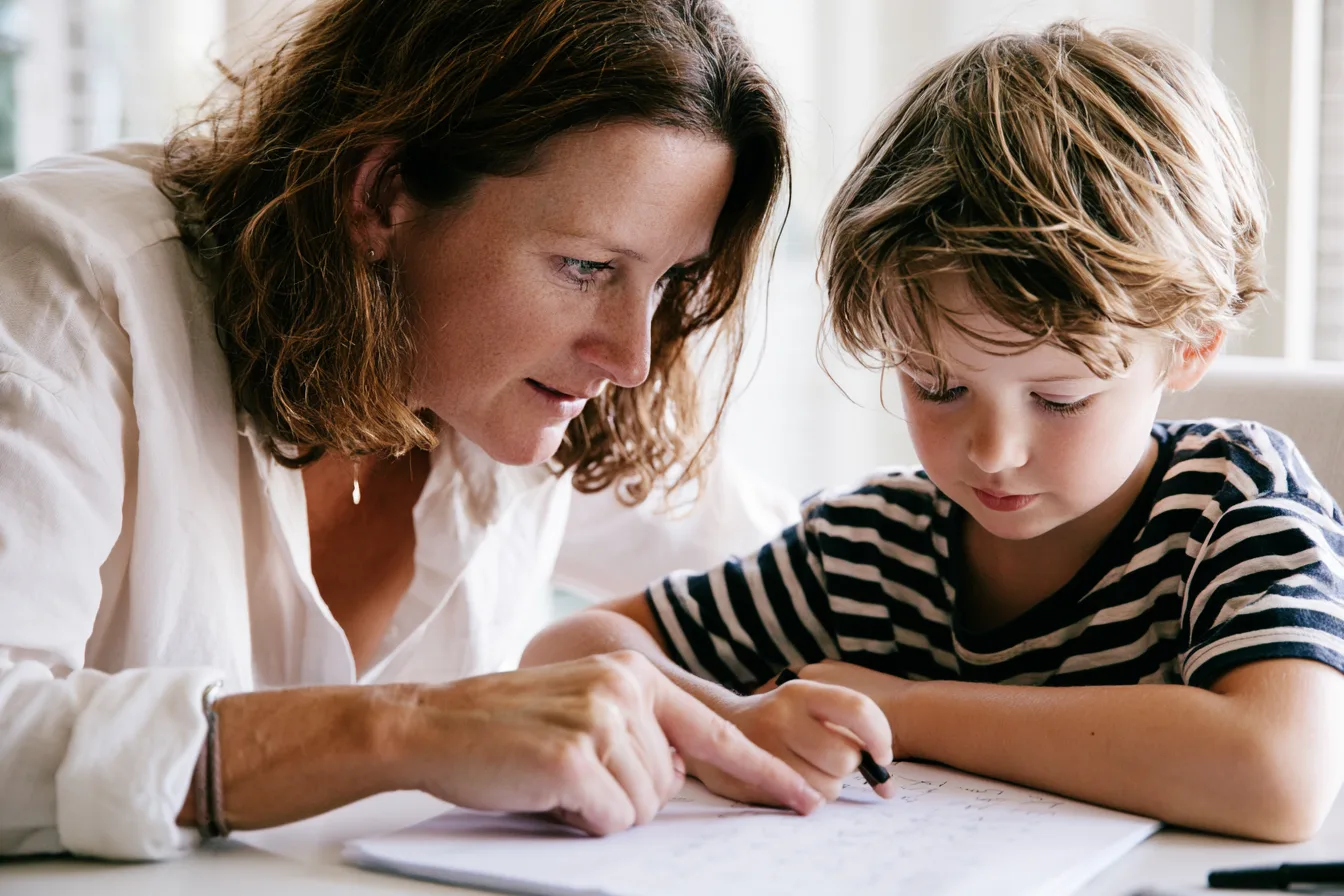
[COVER PHOTO: a parent and child sitting side by side at the kitchen table, leaning together over a school notebook, soft morning light — Caption: School motivation is first cultivated at home, in the small moments of everyday life. — Alt text: parent kindly supporting their child with homework at home, school motivation]
Does your child drag their feet at homework time? Do they tell you school is ’useless’ or that they’re ’no good’ the moment a task gets hard? You are not alone, and above all: you have done nothing wrong. School motivation is not a fixed personality trait that a child is either born with or not. It is something that is built, sometimes lost, and — good news — rebuilt.
This reference page brings together the essentials of what you need to know about school motivation: what it really is, why it fades, and above all what concrete steps you can take, starting tonight, to give your child back the desire to learn. No magic recipes and no extra pressure: simple, doable ideas that respect both your child and you.
📋 The essentials at a glance
- Motivation is not innate: it depends on a sense of competence, autonomy and connection — three levers you can activate at home.
- Lack of motivation is a signal, not a flaw: behind an ’I don’t want to’ there is often a fear of failing, a hidden difficulty or an unmet need.
- Praising effort rather than the grade protects motivation over the long term and reduces performance anxiety.
- External rewards (money, screens, gifts) work in the short term but can erode the desire to learn for its own sake.
- When nothing changes, a learning difficulty or distress may be hiding behind the lack of motivation: there are resources to help you.
In this article
- What exactly is school motivation?
- Why does a child lose motivation?
- Recognizing the signs of fading motivation
- The three levers that feed motivation
- Praise the effort rather than the result
- Rewards and punishments: what really helps
- Defusing the homework battle
- Motivating by age: elementary and high school
- When low motivation hides something else
- FAQ

What exactly is school motivation?
We often talk about motivation as a reserve of energy: some children seem to have ’lots,’ others ’not enough.’ The reality is more nuanced. School motivation is the set of reasons that push a child to engage in a learning task, to put effort into it, and to persevere despite obstacles.
Researchers distinguish two broad families. First, intrinsic motivation: the child acts because the task interests them, entertains them or helps them grow — reading a book because the story grips them, for example. Then, extrinsic motivation: the child acts to obtain an outside consequence — a good grade, a reward, or to avoid a punishment.
Both have their uses. But research suggests that intrinsic motivation is sturdier and leads to deeper, more lasting learning. When a child learns ’for the grade’ only, their interest often fades as soon as the grade disappears. When they learn because they find meaning and pleasure in it, the momentum renews itself.
Your role as a parent, then, is not to ’force’ motivation, but to create the conditions for it to emerge and endure. That is exactly what we will explore.
[PHOTO: a smiling child proudly holding up a drawing or school project they have just finished — Caption: The joy of having succeeded on your own is the most durable fuel for motivation. — Alt text: child proud to show off their successful schoolwork, intrinsic motivation]
Why does a child lose motivation?
No child wakes up one morning deciding to ’stop loving learning.’ Demotivation sets in gradually, often in reaction to repeated experiences. Understanding the cause is the first step to acting in the right place.
The fear of failure comes first. A child who has lived through several disappointments ends up protecting themselves: not trying hurts less than trying and failing. The famous ’I don’t care’ often hides an ’I’m afraid I won’t manage.’
Next comes a lack of meaning. When a child does not see what the learning is for, their brain does not mobilize energy. ’Why do I have to learn this?’ is a legitimate question that deserves a real answer, not a ’because that’s how it is.’
Unidentified difficulties also play a major role. A child who struggles to read, write or count spends enormous energy just keeping up. Exhausted, they disengage — not out of laziness, but out of survival. We will come back to this.
Finally, a climate that is too focused on performance, at home or in class, can turn every assignment into a source of stress. When mistakes are experienced as faults rather than as a normal step, the child tenses up and pulls away.
🔬 What the science says: research suggests that student motivation rests largely on three fundamental psychological needs — feeling competent, feeling free in one’s choices, and feeling connected to others. When one of these needs is lastingly frustrated, school engagement drops, regardless of the child’s efforts or actual abilities.
Recognizing the signs of fading motivation
Demotivation does not always announce itself through a flat-out refusal. It sometimes slips into behaviors we wrongly attribute to laziness or bad will. Learning to spot them allows you to step in early, before discouragement settles in for good.
Here are the signals worth your attention: your child constantly puts off their homework, rushes through their work or finishes it in a few minutes; they put themselves down (’I’m hopeless,’ ’I’m going to fail anyway’); they avoid talking about school or change the subject the moment it comes up; they complain of stomachaches or headaches on school mornings; they have dropped activities they used to enjoy.
📌 Good to know: a single one of these signs, occasionally, is nothing alarming — every child has off days. It is their repetition and accumulation over several weeks that deserve attention. The idea is not to monitor your child, but to stay attuned to changes.
The most useful reflex? Open up the conversation without dramatizing. A simple sentence like ’I get the feeling school has felt heavy lately — am I wrong?’ is worth more than ten pressing questions. You show that you are an ally, not a judge.

The three levers that feed motivation
If motivation rests on three needs — competence, autonomy and connection — then the good news is that you can act on each of them, at your level, without being a teacher or a psychologist.
1. The sense of competence
A child gets motivated when they feel capable. To feed that feeling, break tasks into small reachable steps and celebrate every bit of progress, however tiny. Instead of aiming to ’finish the whole exercise,’ aim to ’do the first three questions.’ Success breeds success: each small win rebuilds confidence.
2. The need for autonomy
Nobody likes feeling controlled. Offer your child real choices, even modest ones: ’Would you rather start with math or French?’, ’Do you want to do your homework before or after your snack?’ These micro-decisions give back a sense of power over their learning, and that power feeds engagement.
3. The sense of connection
A child invests more when they feel supported and understood. Your warm presence, your sincere interest in what they are learning, your patience in the face of their mistakes: all of this weaves a bond that reassures. And a child who feels safe dares, tries, and perseveres.
[PHOTO: a parent listening attentively to their child explaining something, both relaxed in the living room — Caption: Listening without immediately correcting strengthens the bond and, with it, motivation. — Alt text: parent listening to their child talk about school, parental support]
💡 Tip: turn homework time into a moment of connection rather than a tug-of-war. Sit beside them and do your own ’work’ (read, write a list, answer an email) while they do theirs. You create a shared bubble of concentration, without heavy supervision.
Praise the effort rather than the result
Here is one of the most powerful levers — and one of the most counterintuitive. When your child brings home a good grade, the natural reflex is to say ’Well done, you’re so smart!’ The intention is lovely, but this kind of praise can backfire.
Research suggests that praising intelligence (’you’re gifted’) pushes the child to want to preserve that image. As a result, they avoid challenges where they risk failing, because failing would call their ’talent’ into question. Conversely, praising effort, strategy or perseverance (’you worked hard,’ ’I saw you started over without giving up’) teaches them that their progress depends on what they do, not on what they are.
This nuance changes everything. A child who believes intelligence can grow — what we call a growth mindset — faces difficulties with curiosity rather than fear. They see mistakes as useful information, not as a verdict.
In practice, replace compliments about the person with compliments about the process. ’How did you find that answer?’ opens a richer conversation than ’That’s good.’ And when a result disappoints, avoid minimizing (’it’s no big deal’): instead, name the effort and the next step. This is part of what helps to build your child’s confidence in the subjects that intimidate them.
Rewards and punishments: what really helps
’If you finish your homework, you’ll get 30 minutes of game time.’ Who hasn’t used that kind of deal? Rewards are not bad in themselves, but they deserve to be handled with discernment.
The problem with systematic rewards is that they shift attention. The child no longer does the task for its own sake, but for the prize at the end. Research suggests that, over time, an external reward can actually reduce intrinsic motivation: once the carrot is removed, the desire goes out. This is known as the overjustification effect.
As for punishments and threats, they sometimes get immediate obedience, but at the cost of connection and the pleasure of learning. A child who works under fear associates school with stress, which feeds precisely the demotivation we are trying to fight.
| Do | Avoid |
|---|---|
| Encourage effort and strategy | Systematically rewarding every task |
| Highlight progress, even small | Comparing to a sibling or classmate |
| Let the child experience some mistakes | Correcting or doing it for them to save time |
| Offer real, concrete choices | Threatening or removing privileges in anger |
| Value curiosity and questions | Reducing success to the grade alone |
📌 Good to know: if you use rewards, favor those that celebrate a one-off achievement (’let’s go to the park to celebrate finishing your project’) over permanent deals. The celebration marks pride; the deal, on the other hand, buys the effort.
Join the KIADEMY newsletterDefusing the homework battle
For many families, homework is the daily theater of tensions around motivation. Shouting, tears, endless negotiations: the moment meant to consolidate learning becomes a trial for everyone. A few adjustments can transform the mood.
First, establish a stable routine: same time, same quiet spot, no screen nearby. Regularity reduces negotiations, because the brain loves predictability. The child knows that ’after the snack, it’s homework,’ and that becomes a habit rather than a battle to restart every evening.
Next, respect the need for breaks. An eight-year-old cannot hold an hour of concentration in a row. Short blocks (15 to 20 minutes) interspersed with mini-breaks are more effective than a long marathon in which attention crumbles.
Finally, resist the urge to correct everything. Your role is not to guarantee a perfect assignment, but to support a child who is learning. Letting a mistake go through means letting the teacher do their job and giving your child a chance to learn on their own. If homework triggers real distress, it can help to understand how to help them without piling on pressure.
💡 Tip: before starting, ask your child to explain what they have to do. If they can restate the instructions, they are ready to work alone; if they are already stuck there, the problem is not motivation but comprehension — and that is where they need you.
Motivating by age: elementary and high school
Motivation is not fed the same way at 7 and at 14. Adapting your approach to your child’s stage of development makes a real difference.
In elementary school: play and pride
Young children learn through play, curiosity and the desire to please the adults they love. At this age, build on the concrete: handling objects, drawing, telling stories, turning a lesson into a fun challenge. The pride of ’doing it all by myself’ is a powerful engine. Avoid overloading: preserving the pleasure of learning is worth more than piling up review hours.
In high school: autonomy and meaning
The teenager needs their growing need for independence to be respected. Head-on control (’do your homework now’) often triggers the opposite effect. Bet instead on dialogue, on projects that mean something to them, and on the link between what they learn and their aspirations. Help them set their own goals: a goal you choose is far more motivating than one imposed on you.
[PHOTO: a teenager working on a laptop, focused, in a bright corner of the home — Caption: In adolescence, autonomy and meaning become the main drivers of school engagement. — Alt text: focused teenager studying at home, motivation in high school]
Whatever the age, one principle remains: your child gets more motivated when they feel like an agent in their learning, not a mere executor. It is largely a matter of stance, and that stance can be learned, on both sides.
When low motivation hides something else
Sometimes, despite all your efforts, nothing moves. The child keeps closing up, suffering, putting themselves down. In that case, the lack of motivation is not the cause of the problem: it is the symptom.
An undiagnosed learning difficulty — such as dyslexia, dysorthographia or dyscalculia — exhausts the child and feeds a chronic sense of failure. Understanding where to start with learning difficulties can shed light on many behaviors we wrongly attributed to a lack of desire. Our full dossier on learning difficulties and disorders details the signs to watch for and the paths to action.
A broader distress — anxiety, bullying, conflict, grief, separation — can also translate into school disengagement. School is never cut off from the rest of a child’s life.
If doubt persists, do not hesitate to ask for help. Talking to the teacher, then possibly consulting a learning specialist, helps clarify things. Seeking support is not an admission of parental failure: on the contrary, it is one of the finest acts of motivation you can offer your child.
📌 Good to know: a child who ’doesn’t want to’ almost always has, somewhere, a ’can’t’ or an ’is afraid to.’ Looking for what hides behind the refusal will spare you many pointless conflicts and bring you closer to the real solution.
FAQ
How do I motivate a child who says they hate school?
Start by listening without correcting: ’What’s the hardest part of school for you?’ Behind the ’I hate it’ there is often a specific subject, relationship or difficulty. Once the real cause is identified, act on it rather than on the ’I hate it’ in general. Also value the rare positive moments to rebuild, little by little, a calmer relationship with learning.
Should I pay my child for good grades?
It is not advised as a permanent strategy. Paying for grades shifts attention from learning to the reward, and can weaken the desire to learn once the money is removed. Prefer to occasionally celebrate a notable achievement and, above all, to value the effort made. The goal is for your child to learn in order to grow, not to cash in.
My child is motivated for sports but not for school. Why?
Because sport often offers what school lacks: an immediate sense of competence, autonomy and a strong sense of belonging. Rather than pitting the two against each other, take inspiration from sport: clear goals, visible progress, pleasure and encouragement. These ingredients that motivate them on the field can, in part, be recreated around school learning.
When should I start worrying about a lack of motivation?
When the demotivation lasts several weeks, comes with signs of distress (sleep problems, physical aches, isolation, marked self-deprecation) or spreads to areas beyond school. In those cases, talk to the teacher and consider a professional opinion. Better to consult for nothing than to let a difficulty quietly settle in.
Do screens harm school motivation?
Screens are not the enemy, but excessive use can compete with the time and energy available for learning, and accustom the brain to instant gratification. The issue is balance: clear rules, screen-free windows, and offline activities that feed curiosity. A screen used as a supervised learning tool can even become an ally.
How do I keep my child motivated over the long term?
By cultivating meaning rather than pressure. Connect learning to real life and to your child’s interests, celebrate progress more than results, and preserve the bond even on hard days. Lasting motivation does not come from a single burst, but from a climate of trust maintained day after day, where mistakes are allowed and effort is recognized.
In conclusion
Your child’s school motivation is not a fate set in stone. It is fed by competence, autonomy and connection — three levers you activate, often without knowing it, in the most ordinary gestures of everyday life. Encouraging effort, defusing pressure, listening to what hides behind a refusal: that is what durably reignites the desire to learn. And on the days you doubt, remember that your kind presence is worth, on its own, more than all the reward systems in the world. At KIADEMY, we believe learning should remain an adventure driven by curiosity — and that every child deserves support that respects their own pace.
Join the waitlistWas this article helpful?


